Portfolio Jewish Heritage
Museum collections, searchable by period
An online database of Judaica and the institutions that hold it: a detailed scientific description of every object, faceted search by material, technique and period, and a public catalogue in two languages.
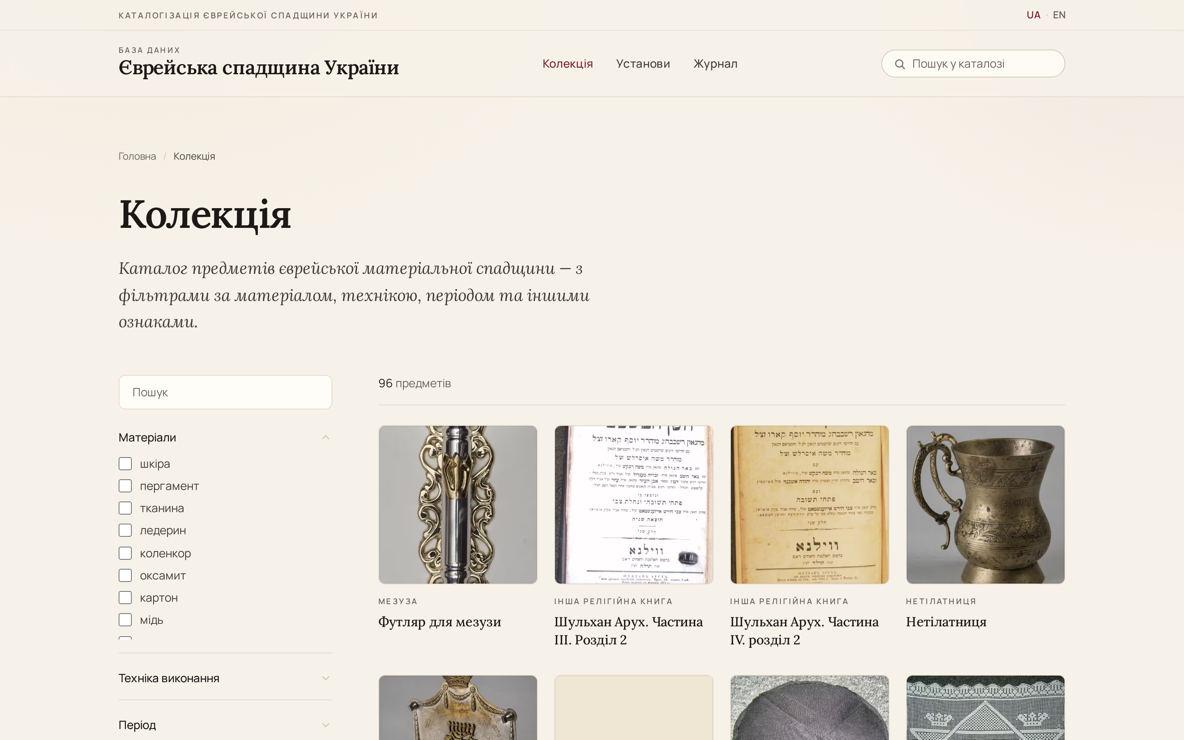
Project
Jewish Heritage
- Client
- A project preserving Jewish cultural heritage Collections of Judaica and the institutions that keep them, opened up to researchers and a wide audience.
- System
- A cataloguing tool and a public catalogue in one Built on our own CMS, eEgnith 8. All the data built up over the years moved over from the old site, which was no longer developed.
- Site
- Public catalogue Live at database.jewishheritage.org.ua ↗ (opens in a new tab)
- Our part
- Domain analysis, database design, admin and public sides, data migration Also the museum description structure, redirects and SEO, testing and roll-out.
- Stack
-
- PHP
- Laravel
- Filament
- Livewire
- eEgnith 8
- MariaDB
The task
A scientific description that people can search
A museum object is described by dozens of characteristics. The description had to stay scientifically correct and still be searchable, by specialists and by visitors with no training in the field.
Dozens of characteristics per object
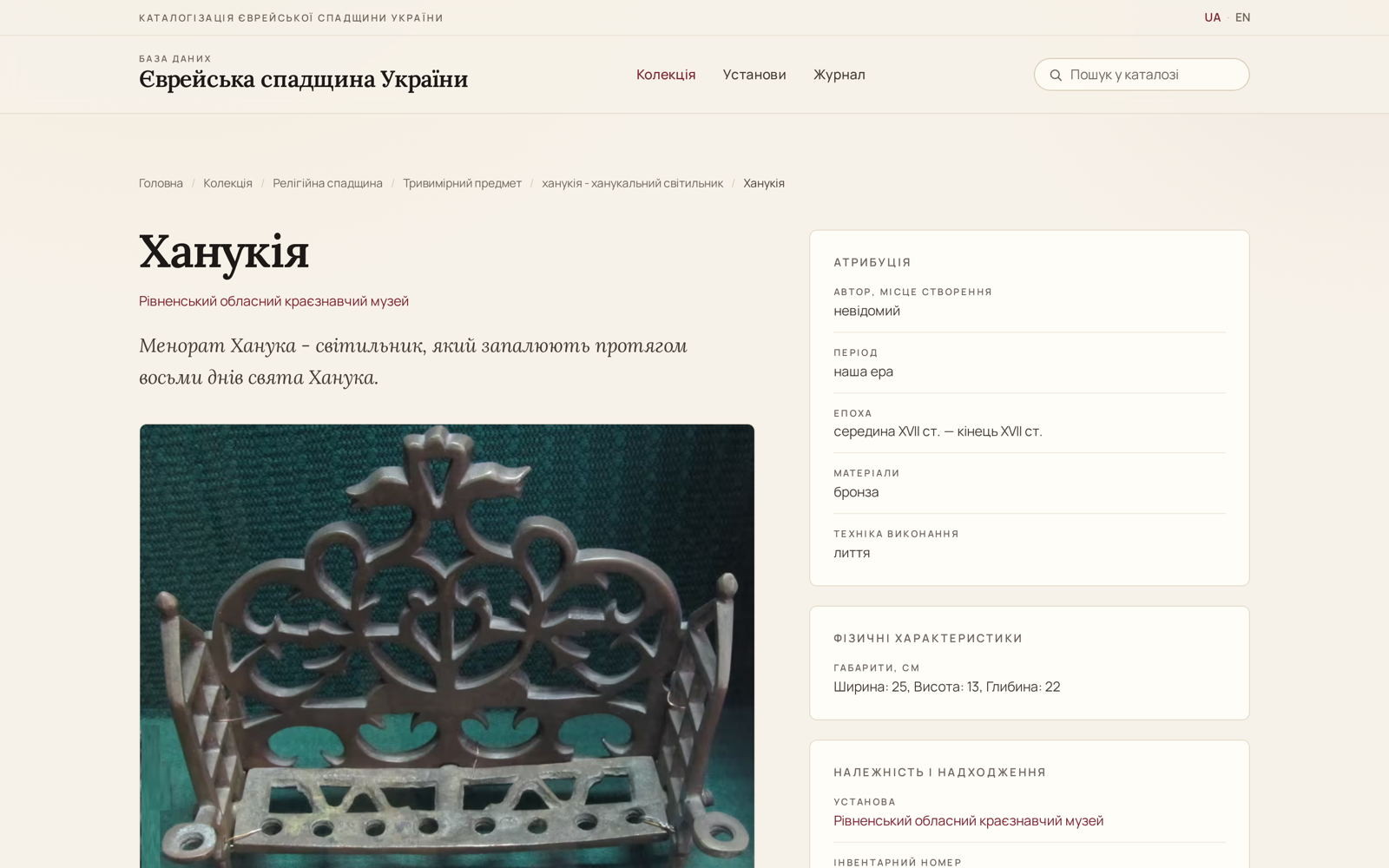
Inventory numbers, dating, materials, technique, the religious holiday or life-cycle stage, condition, restorations, transfers, dimensions, weight, provenance, source of acquisition, marks and inscriptions.
Dates that are periods
Objects are dated by period, such as “mid-19th century”, so the period had to be stored as structured data that sorts and filters correctly.
Data that already existed
Everything was on an old site running an outdated platform. It had to move without loss, keeping the links between objects, institutions and directories. Old page addresses had to lead to the new ones so search rankings weren’t lost.
Two languages, clear search
The public side had to be bilingual, with live search and filters that make sense to a general visitor as well as a specialist.
Solution
Objects, institutions and eras as structured data
Objects and institutions
Two main entities, each with its own category tree. An object belongs to an institution, so an institution’s page shows its holdings, and the catalogue can be browsed as a whole or one collection at a time.
Eight managed directories
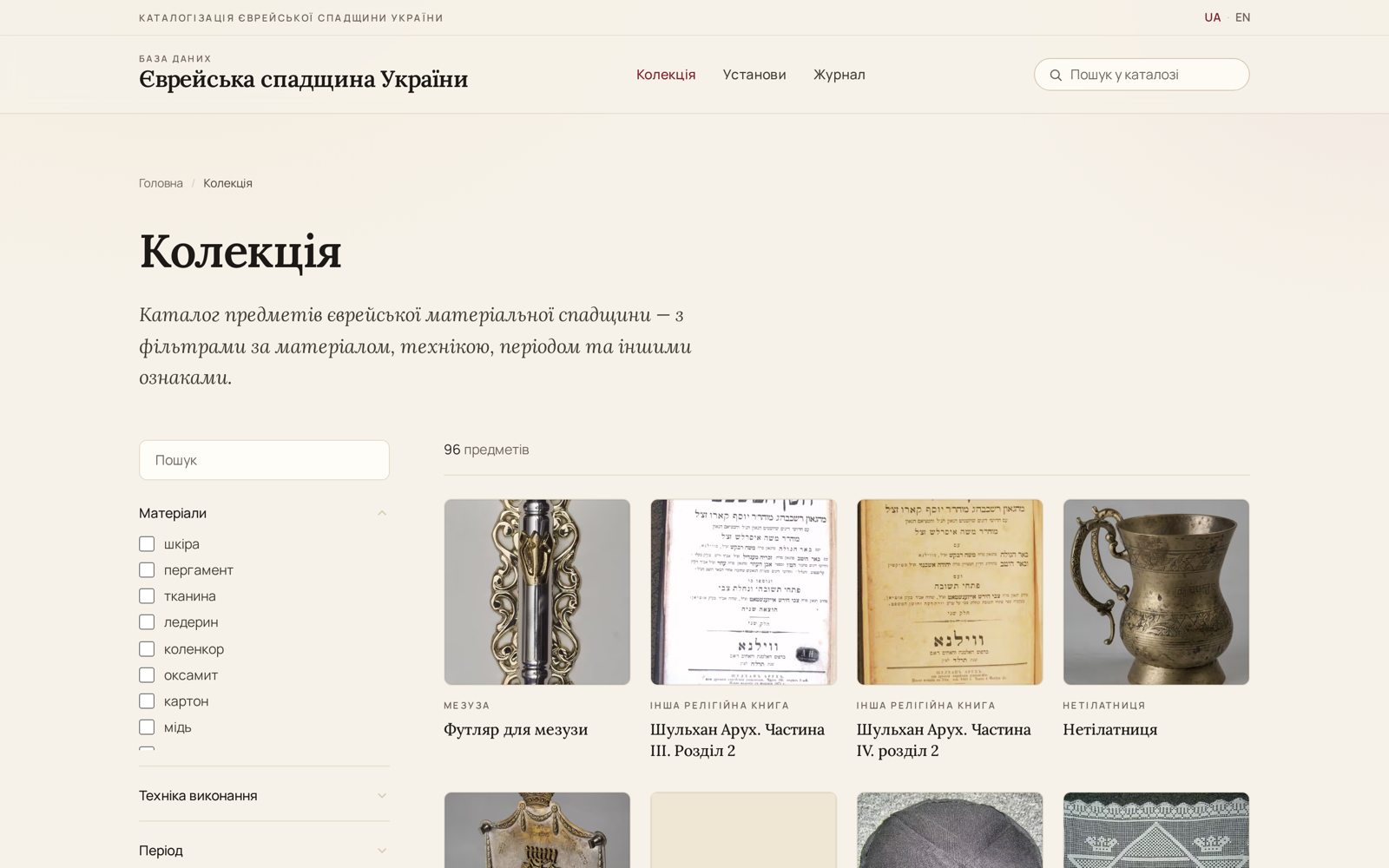
Materials, technique, period, religious holiday or life-cycle stage, condition, restoration, transfers and place of storage. The same directories become the facets of the public filter, so editors extend the search filters by editing the directories.
A directory of eras
Dating is a structured directory of eras: centuries refined as early, mid or late, sorted chronologically, with ranges from one era to another. Every text field keeps a Ukrainian and an English version.
A migration you can rerun
The old site’s data came over through a separate migration that can be run again: it keeps the original record IDs, so a rerun creates no duplicates, restores the links to directories and builds the redirects from old addresses to new ones.
Addresses built from names
Page addresses are built from names, from the section through the categories down to the object. When a category is renamed, the addresses of everything in it are rebuilt and the old ones stay as redirects.
A catalogue for everyone
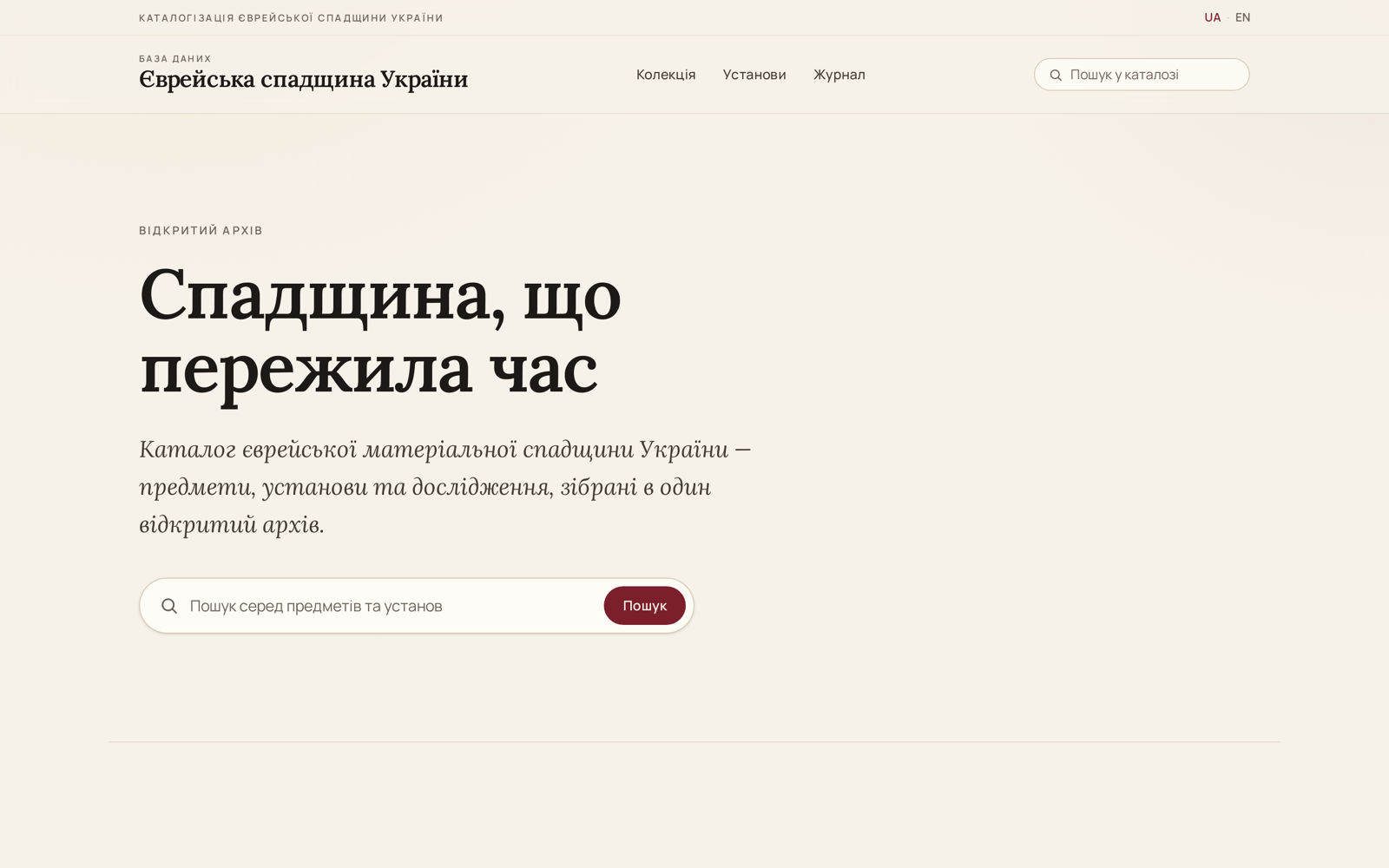
The public side has a faceted catalogue, instant search with suggestions, and object and institution pages with blocks of characteristics and structured data for search engines.
Screens
Inside the catalogue
Capabilities
What the catalogue does
01 · 6
Catalogue
- Museum objects with a scientific description
- Register of the institutions that hold collections, with a category tree
- Each institution’s holdings as part of the whole catalogue
- Inventory numbers, dimensions, weight, volume and exhibition data
- Provenance, source of acquisition, marks and recommendations
- Image and video galleries per object
02 · 4
Description
- Eight managed directories for describing objects
- A structured directory of eras, sorted chronologically
- Dating as a from–to range
- Bilingual content: a separate version of every text field
03 · 5
Search and SEO
- Faceted search of the public catalogue by all the directories
- Instant site-wide search with suggestions
- Hierarchical page addresses, built automatically
- Old addresses kept through automatic redirects
- SEO settings, structured data, sitemap and robots.txt
04 · 4
Migration and admin
- Data migrated from the old site, with reruns possible
- Scheduled publishing and visibility set per language
- Change log that groups edits into one action
- Role-based access to the admin panel
Result
One structure for every collection
Objects from all the institutions are now described in one structure and one database, and the public catalogue lets anyone search them by material, technique, period or holiday.
The old site’s data moved over in full and its old addresses still work, so the project’s history and search rankings were kept. Editors extend the description through the managed directories, and the bilingual catalogue opened the collections to researchers abroad.